
7 Ways to Attract Visitors to Okinawa’s Tourism Industry | Web Strategies That Stand Out for Hotels, Restaurants, and Activity Providers
2026/11/23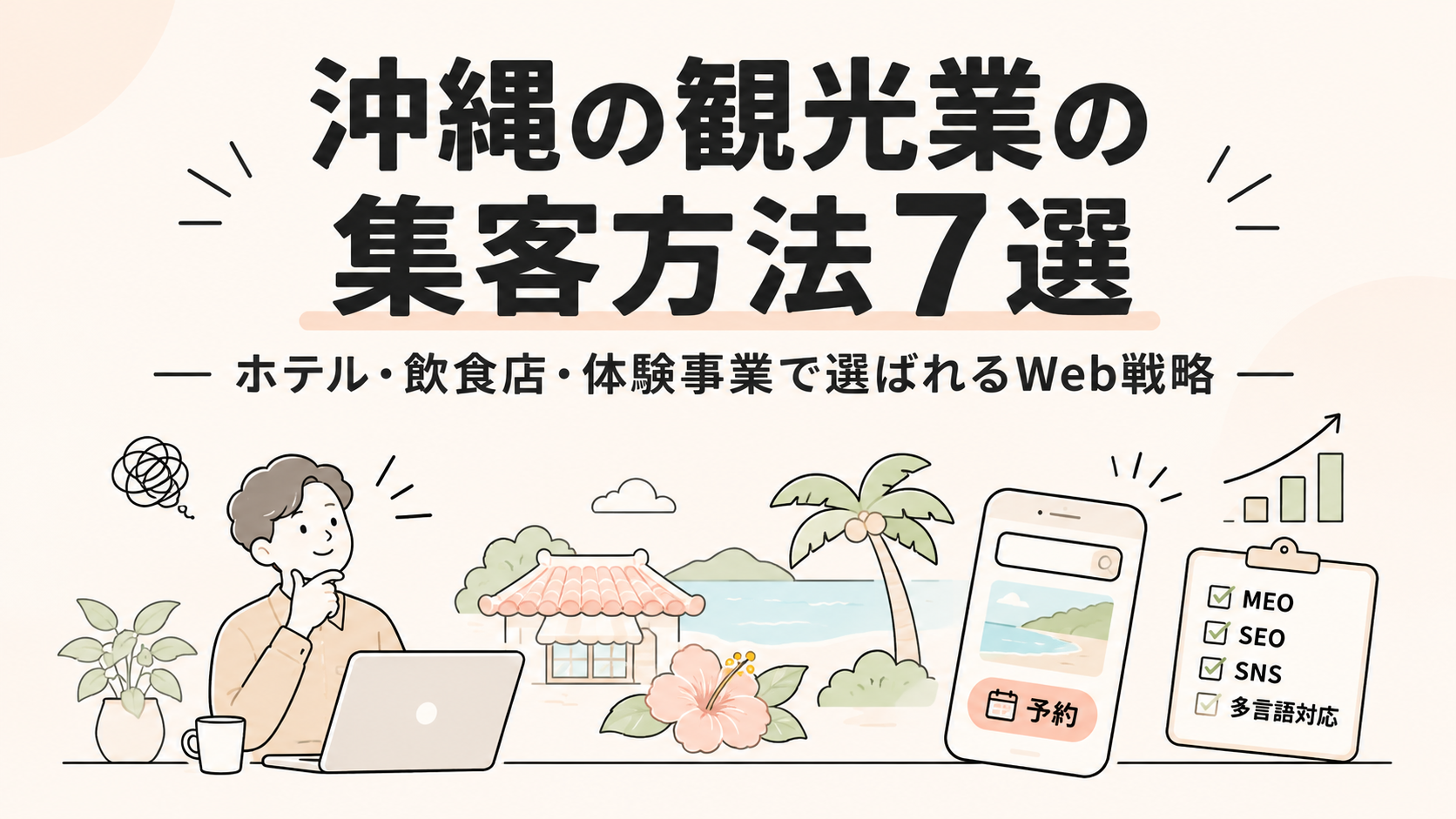
“Even though the number of tourists visiting Okinawa is increasing, I’m still not getting many customers at my store.”
“I’m putting a lot of effort into Instagram, but I’m not sure if it’s actually leading to reservations or sales.”
“I want to be able to attract customers on my own, without relying on booking sites.”
Many people running tourism-related businesses in Okinawa likely share these concerns.
Okinawa is a tourist destination that attracts many travelers from both Japan and abroad. There are business opportunities for a wide variety of businesses, including hotels, vacation rentals, restaurants, marine activities, tourist experiences, and souvenir shops.
However, an increase in tourists does not automatically mean more reservations or foot traffic for your business.
Travelers research information online before departure and decide which shops to visit or services to use by comparing options on Google Maps, social media, and booking sites.
That’s why it’s crucial to create a system that allows tourists to find you, choose you when comparing options, and ultimately make a reservation or visit your business.
I lived in Okinawa for six years, and I currently provide support for website development and online customer acquisition, primarily for businesses in Okinawa.
What I’ve observed in the field of web development is that simply managing your website, Google Maps, and social media separately may not allow you to fully capitalize on valuable opportunities to attract customers.
In this article, I’ll explain seven customer acquisition methods to implement in Okinawa’s tourism industry, along with specific examples from hotels, restaurants, and experience providers.
I’ll introduce strategies you can implement even with limited budgets and staff, so please use this as a reference to identify the methods that best suit your business.
Why Customer Acquisition Strategies Are Crucial for Okinawa’s Tourism Industry
While demand for tourism in Okinawa remains high, if tourists aren’t aware of your business, it won’t lead to reservations or visits. In particular, it’s crucial for the Okinawan tourism industry to cater to both pre-trip research and on-site searches.
Okinawa’s 2025 Inbound Tourist Numbers Set a New Record
According to the “Reiwa 7 (Calendar Year) Okinawa Prefecture Inbound Tourist Statistics Overview (Final Version)” published by Okinawa Prefecture, the number of inbound tourists to Okinawa Prefecture in 2025 was 10,756,000, an 11.2% increase from the previous year.
This is the highest figure ever recorded for a calendar year.
Domestic tourist arrivals also reached a record high, and international tourist arrivals exceeded the previous year’s figures.
Source: Okinawa Prefecture, “Publication of Overview of Inbound Tourists”
However, this figure represents the total number of tourists for Okinawa Prefecture as a whole.
Even if the number of travelers to Okinawa is increasing, it does not necessarily mean that demand for your business’s catchment area or services will increase at the same rate.
For example, the purposes of travelers visiting restaurants in Naha City differ from those visiting resort facilities in Onna Village, as do the most effective methods for attracting customers.
What’s important is not just looking at the total number of tourists visiting Okinawa, but understanding where potential customers for your business are located and what they’re looking for.
Travelers gather information through multiple channels
Let’s consider the process by which travelers plan a trip to Okinawa.
When looking for a hotel, they might use a booking site; to find a café they’d like to visit, they might search on Instagram; and for lunch on the day of their trip, they might search on Google Maps.
When booking marine activities, they might search Google for terms like “Okinawa snorkeling recommendations” and compare official websites and booking sites.
In other words, it’s not enough to focus on just one channel.
First, let’s break down travelers’ behavior.
| Traveler Behavior | Main Sources of Information | What Businesses Should Prepare |
|---|---|---|
| Planning a Trip to Okinawa | Google Search, social media, travel information sites | Content that Conveys the Destination’s Appeal and SEO Strategies |
| Comparing Accommodations and Activities | Official Websites, Booking Sites, and Customer Reviews | Organizing Pricing, Photos, Features, and Booking Methods |
| Finding Local Businesses | Google Maps, Social Media | MEO strategies and accurate business information |
| Deciding to Book or Visit | Official Website, Booking Form, Phone | Clear and intuitive booking process |
| Sharing Experiences After the Trip | Google Reviews, Social Media | Responding to Reviews and Sharing Information That Encourages Return Visits |
As you can see, the necessary strategies vary depending on whether it’s before, during, or after a trip.
It’s important to consider at which stage your customers most often search for services and choose your customer acquisition methods accordingly.
7 Recommended Customer Acquisition Methods for Okinawa’s Tourism Industry
There are seven customer acquisition methods that the Okinawa tourism industry should focus on: Google Maps optimization, SEO, social media, multilingual support, improving the booking process, online advertising, and reviews and local partnerships. Since each plays a different role, combine them according to your business type and specific challenges.
① Get Discovered by Local Tourists Through Google Maps and MEO
If you operate a physical location—such as a restaurant or tourist attraction—the first step is to ensure your information on Google Maps is up to date.
To manage your business information on Google Maps, use Google Business Profile.
For example, imagine a traveler searching as follows:
- Kokusai Street Okinawan cuisine
- Naha breakfast
- Onna Village, cafes
- Miyako Island car rental
- Ishigaki Island marine activities
For searches like these, the business information displayed on Google Maps serves as a key factor in choosing a place to visit.
Efforts to improve discoverability on Google Maps are generally referred to as MEO strategies.
Specific Actions to Take
- Accurately register the business name, address, and phone number
- Set a business category appropriate for your industry
- Update business hours, regular closing days, and temporary closures
- Add plenty of photos of the store’s exterior, interior, products, and services
- Set up a link to the official website
- Check reviews and respond politely
- Set up reservation links and other features based on available functionality
For example, if you run a restaurant in Naha, posting not only photos of the food but also the exterior of the entrance, the atmosphere of the dining area, and the menu will help travelers visualize what it’s like to visit your establishment.
For car rental agencies, it’s important to provide information on pickup locations, return procedures, and how to get there from the airport.
Additionally, for hotels, Google’s display and booking features differ from those for general restaurants.
Since hotel rates and booking links are tied to systems like Google Hotel Ads and free booking links, some features cannot be set up simply by entering a URL in a standard Business Profile.
Reference: Google’s official “Getting Started Guide for Hotel Business Profiles”
Please note that MEO strategies do not guarantee search rankings.
Start by accurately conveying the information travelers want to know and making it easy for them to decide whether to visit or make a reservation.
AT.DESIGN also offers Google Maps MEO services.
② Attract Customers Through Pre-Trip Searches with SEO
If you want to attract customers even before their trip, optimizing your website for SEO is crucial.
SEO refers to efforts to make your website easier to find on search engines like Google.
For example, someone planning a trip to Okinawa might search using keywords like the following:
- Okinawa snorkeling for beginners
- Onna Village, family-friendly hotels
- Naha, Okinawan cuisine, private rooms
- Miyako Island SUP experience
- Ishigaki Island, Rainy Day, Sightseeing
By providing detailed information about your company’s services in response to these search queries, you can establish a connection with potential customers right from the trip-planning stage.
However, it’s not enough to simply target keywords with high search volumes.
For example, if you offer cooking experiences for small groups in Naha City, it may be more appropriate to consider keywords that combine your service details with the local area—such as “Naha Okinawan cuisine experience”—rather than a broad keyword like “Okinawa sightseeing.”
Information to Include on Your Website
- Service Details and What Visitors Can Experience
- Prices, duration, and location
- Target age range and participation requirements
- What to Bring and Recommended Attire
- Policy for Rainy or Bad Weather
- Cancellation Policy
- Directions & Parking
- How to Make a Reservation and Contact Information
For example, with marine activities, it’s important to answer questions such as “Can I participate even if I can’t swim?” and “What is the minimum age for children to participate?”
For hotels, factors such as room features, amenities for children, parking, and access to nearby tourist attractions are key considerations.
Creating pages that address travelers’ questions lays the foundation for attracting customers and generating bookings.
Additionally, adding internal links from related blog posts to booking and service pages makes it easier for travelers to find the information they need.
SEO doesn’t guarantee results just by publishing a large volume of articles.
Start by optimizing your existing service pages, and then expand your content with articles that answer travelers’ questions.
Reference: Google’s official “SEO Starter Guide”
③ Showcase Okinawa’s Unique Experiences on Instagram and Social Media
Many sectors of Okinawa’s tourism industry are well-suited for photos and videos.
This is because you can visually showcase attractions that are difficult to convey through text alone—such as the beautiful ocean and nature, as well as cuisine, activity highlights, staff hospitality, and the atmosphere of the facilities.
For example, if you run a marine activity business, you can use short videos to show the flow of the tour—from the meeting point to the end of the experience—in addition to footage of the ocean.
For restaurants, showing how dishes are served and the atmosphere inside the restaurant helps travelers visualize what their visit will be like.
Social Media Content to Share in the Tourism Industry
- Scenes of people actually participating in the experience
- Staff Introducing Services
- Guides for first-time visitors
- Seasonal recommendations
- How to Combine Your Visit with Nearby Attractions
- Answers to Frequently Asked Questions
- Customer Testimonials and Feedback
For example, with a snorkeling video, including not only beautiful underwater footage but also explanations for beginners and safety precautions makes it easier for first-time participants to decide whether to join.
However, view counts and follower counts aren’t the only things that matter on social media.
No matter how many people see your content, if it doesn’t lead to bookings, it may not be considered a sufficient business success.
Include links to your official website and booking page in your profile so that people who see your posts know what to do next.
Also, you don’t need to manage every social media platform.
It’s important to choose a strategy you can sustain without straining yourself, taking into account the time you can dedicate to creating photos and videos, as well as the platforms your target customers use.
④ Reduce Anxiety Among Foreign Tourists Through Multilingual Support
If you’re targeting international tourists, consider offering multilingual support.
However, multilingual support isn’t just about translating the text on your website into foreign languages.
Travelers want to know not only the details of your services but also pricing, booking conditions, how to get there, and important notes.
For example, if you offer marine activities for international tourists, you might consider clearly conveying the following information:
- Languages Supported
- Activity fees and payment methods
- Meeting place and time
- Participation requirements and age restrictions
- Items to Bring
- Safety Precautions
- Cancellation and Refund Policy
- How to Make a Reservation or Inquire
In particular, care must be taken to avoid misunderstandings regarding cancellations due to inclement weather and safety-related instructions.
Points to Keep in Mind for Multilingual Support
First, identify the countries and regions where your company’s services are most frequently used, as well as the markets you wish to attract in the future.
You don’t need to support many languages from the start.
For example, you could prioritize Japanese and English first, then add other languages based on actual inquiry volume.
When publishing your website in multiple languages, it is often best to create separate pages for each language and design the site to clearly indicate to search engines that these are distinct language versions.
Google provides guidance on methods such as hreflang to indicate multilingual pages to search engines.
Reference: Google Search Central “Multilingual and Multiregional Sites”
Also, even when using translation tools, be sure to verify the content of important information such as prices and terms of use.
Multilingual support not only increases traffic from international tourists but also helps them feel confident in making a purchase.
⑤ Improve the booking flow on your website
One aspect of attracting customers in the tourism industry that is often overlooked is the user journey after visitors arrive at the website.
Even if visitors arrive via ads, social media, or Google Search, they may leave if the booking process is unclear.
For example, does your website look like this?
- The booking button is located only at the very bottom of the page
- The booking form is difficult to use on a smartphone
- Prices and availability cannot be checked
- It’s unclear why users are redirected from the official website to a booking site
- The cancellation policy is hard to find
- The only way to contact the hotel is by phone
Assume that travelers will be accessing your site from a smartphone, and aim to make it easy for them to find the information they need with minimal steps.
Basic Structure of a Page That Leads to a Booking
- A title that clearly explains what experiences and services are available
- Photos and videos that convey the appeal of the service
- Basic information such as price, duration, and location
- Testimonials and case studies from actual users
- Participation requirements, precautions, and cancellation policy
- An easy-to-use booking button
- Frequently Asked Questions and Contact Information
For example, for a guided tour, you can place the booking button right next to the pricing and participation requirements.
For restaurants, make sure users can proceed to make a reservation or submit an inquiry right after checking the menu and business hours.
For lodging facilities, the user flow leading up to checking room availability and rates is also important.
However, if you’re using a booking site, there’s no need to switch everything over to your own booking system right away.
Booking sites serve the purpose of creating touchpoints with new customers.
At the same time, it’s important to enhance your official website so you can convey the unique features of your facility in detail.
Clarify the roles of the booking site and your official website, and develop a system that makes it easier to secure reservations for your business as a whole.
⑥ Use online ads to target specific time periods and audiences
If you want to boost customer acquisition in the short term, online advertising is another option.
SEO is a strategy designed to ensure your site is consistently found through search, but it can take time for your site to appear in search results.
In contrast, with ads, you can set a budget and delivery criteria to deliver information to specific users.
For example, here are some ways you can utilize them:
| Types of Ads | Examples of Use |
|---|---|
| Google Search Ads | Reach people searching for activities and accommodations in Okinawa |
| Instagram and Facebook Ads | Convey the appeal of your services using photos and videos |
| Remarketing Ads | Consider re-engaging visitors to your website |
For example, for marine activities, you can run Google Ads targeted at keywords searched by people considering participation.
For restaurants and tourist attractions, social media ads using videos and images that highlight your unique features are also worth considering.
Things to Check Before Launching an Ad Campaign
However, running ads does not necessarily guarantee an increase in reservations.
If the landing page after clicking the ad is confusing, you may end up spending money on ads without generating any results.
Therefore, it’s important to confirm the following points before launching your ad campaign.
- Who do you want to use your service?
- Are the target region and audience appropriate?
- Does the ad content match the landing page?
- Is it easy to make a reservation from a smartphone?
- Can you measure the results of reservations and inquiries?
- How much are you willing to spend on advertising to acquire a single reservation?
Even with a small advertising budget, you can still narrow down your focus and run tests.
Rather than investing a large budget from the start, it may be more appropriate to clearly define the services you want to promote and your goals, and then test them on a small scale.
⑦ Expand Your Customer Base Through Word-of-Mouth, Local Partnerships, and Repeat Customer Initiatives
In the tourism industry, in addition to attracting new customers, word-of-mouth and referrals from actual users are also important.
Since travelers often choose services in places they’re visiting for the first time, feedback from actual users can be a key factor in their decision-making.
For example, someone participating in a marine activity for the first time might want to know if the staff was courteous or if safety precautions were in place.
For restaurants, information beyond just the taste of the food—such as service quality, the atmosphere of the restaurant, and whether it’s family-friendly—can be particularly helpful.
How to Use Reviews to Attract Customers
- After providing a service, gently encourage customers to post reviews
- Pay attention not only to positive reviews but also to feedback that can lead to improvements
- Respond thoughtfully to reviews
- With the customer’s permission, feature their feedback on your website
- Incorporate common concerns and questions into service improvements
Please avoid any practices that violate Google’s policies, such as offering incentives based on the content or rating of reviews.
In Okinawa, collaborating with nearby businesses is also an option.
For example, accommodations could refer guests to nearby activity providers, or activity providers could recommend local restaurants.
If local businesses can share information with one another, this will lead to convenient guidance for travelers.
Furthermore, consider strategies to attract repeat customers and those referred by others.
You can send information about new services after their trip or introduce plans they can use on their next visit to Okinawa.
However, when maintaining ongoing contact via email, LINE, or similar platforms, it is essential to obtain user consent and handle personal information with care.
Don’t treat it as a one-time transaction; aim to build a relationship where travelers will remember you the next time they visit Okinawa.
By Industry | How to Choose Customer Acquisition Methods Suited to Okinawa’s Tourism Industry
Even within the tourism industry, customer behavior and booking patterns differ among hotels, restaurants, experiential tours, and souvenir shops. It’s important to select the customer acquisition strategies that best suit your specific business sector.
| Industry | Priority Strategies | Key Information to Communicate |
|---|---|---|
| Hotels, Vacation Rentals, and Other Accommodations | SEO, booking sites, official website improvements, multilingual support | Rooms, Facilities, Rates, Location, Booking Terms |
| Water Sports & Experiential Tours | SEO, Social Media, Online Advertising, Booking Funnel | Activity Details, Participation Requirements, Safety Information, Cancellation Policies |
| Restaurants & Cafes | Google Maps, Reviews, Social Media | Menu, Prices, Hours of Operation, Store Atmosphere |
| Souvenir Shops & Retail Stores | Google Maps, Social Media, E-commerce Sites | Products, Prices, Store Locations, How to Purchase |
| Car Rentals & Transportation Services | SEO, Google Maps, and Booking Page Optimization | Pickup Locations, Rates, Vehicle Types, Terms of Use |
For Hotels and Vacation Rentals, Distinguish Between the Roles of Booking Sites and Official Websites
For accommodations, it’s important to use booking sites to create new touchpoints with customers while also conveying the property’s appeal in detail on the official website.
For example, for family-friendly accommodations, factors such as room size, children’s amenities, and the availability of a kitchen or washing machine are key considerations.
There are ways to carefully highlight these features—which booking sites often cannot fully convey—on your official website.
Additionally, if you want to boost direct bookings, review how easy it is to book and whether the terms and conditions are clear.
Please note that the rate display and booking links for hotels on Google Search operate differently from standard business booking links.
If necessary, it’s important to verify the integration requirements between your booking system and Google Hotel Center.
Experience Tours Convey Both “Fun” and “Peace of Mind”
For marine activities and cultural experiences, fun-looking photos and videos serve as a catalyst for sparking interest.
On the other hand, for first-time participants, information that alleviates their concerns is also important.
For example, information such as the following:
- Can beginners participate?
- Can young children participate?
- What items do I need to bring?
- How long does it take?
- What happens in case of rain or strong winds?
- What languages do the staff speak?
Let’s plan a process that uses photos to spark interest, provides detailed explanations to put customers at ease, and leads to a reservation.
Restaurants and souvenir shops should prioritize optimizing for local search results
For restaurants and souvenir shops, it can be crucial to cater to travelers who are looking for a place to eat or shop after arriving in Okinawa.
Therefore, it’s important to ensure that your Google Maps listing includes accurate business hours, photos, menus, and directions.
In particular, since travelers are navigating an unfamiliar area, details such as the availability of parking and the location of the entrance are key factors in their decision-making.
For souvenir shops, you can also showcase your product lineup and purchasing methods on your website or social media.
Depending on the product, you may also want to consider setting up a system that allows travelers to repurchase items online after their trip.
5 Common Mistakes in Attracting Customers in Okinawa’s Tourism Industry
Even if you’re actively working to attract customers, your efforts may not yield sufficient results if your objectives are vague or the path to making a reservation isn’t well-defined. Here, we’ll introduce five patterns to watch out for in particular.
① Relying Solely on Instagram Posts
Even if you post attractive photos on Instagram, it’s unlikely to lead to bookings if users can’t navigate from your profile to the booking page.
Use social media as a tool to build awareness and spark interest, and make sure to provide clear pathways to your official website and booking page.
② Outdated Information on the Website
If information such as business hours, rates, menus, and package details isn’t updated, it can lead to confusion among travelers.
In particular, if you have seasonal operating hours or weather-related changes, make sure the latest information is readily available.
③ Your target audience is unclear
If you try to target “all tourists visiting Okinawa,” the message you’re trying to convey may become too broad.
For example, even for the same snorkeling activity, the information that matters most differs between families with children and experienced divers.
It’s important to clearly identify the customers who are the best fit for your business’s strengths.
④ Focusing solely on traffic and follower counts
When attracting customers online, don’t just look at traffic or follower counts—check whether they’re leading to bookings or inquiries.
For example, if your social media views are increasing but the number of reservations remains unchanged, there may be room to reevaluate your content or the booking process.
⑤ Running ads without checking their effectiveness
Online advertising doesn’t end once the ads are launched.
It’s important to track which ads led to reservations and how much return you’re getting on your ad spend.
If you’re not adequately measuring your results, start by setting up a proper tracking system to create a foundation for improvement.
If you’re starting to attract customers in Okinawa’s tourism industry, where should you begin?
If you’re working with a limited budget and staff, you don’t need to launch every initiative at once. Start by assessing your current customer acquisition situation and focus on improving the areas most likely to lead to reservations or in-person visits.
STEP 1 | Assess Your Current Customer Acquisition Situation
First, identify where your customers are coming from.
For example, let’s organize the following items:
- Inquiries and route searches from Google Maps
- Website traffic from Google Search
- Website visits from Instagram
- Number of reservations from booking sites
- Number of reservations made through the official website
- Number of Inquiries via Phone and Contact Forms
It’s okay if you don’t have exact figures for everything.
First, let’s organize the information you currently have.
STEP 2 | Decide Which Areas to Improve First
For example, if a restaurant has very little information listed on Google Maps, the first step might be to update its business profile.
For an experience provider that gets website traffic but few reservations, improving the reservation page might be a priority.
For an accommodation provider with low traffic to its official website, one option is to review search keywords and the site’s content.
Based on the specific challenges, narrow down the initial actions to one or two.
STEP 3 | Create a 3-Month Improvement Plan
For example, you might proceed as follows:
| Timeframe | Actions to Take |
|---|---|
| Month 1 | Analyze the current situation; update basic information on Google Maps and the official website |
| Month 2 | Improving service pages, posting photos and social media content, and reviewing the booking process |
| Month 3 | Reviewing traffic and booking data; testing ads as needed |
This is merely one example of a potential approach and does not guarantee results within three months.
The appropriate schedule will vary depending on your business’s peak season and the current state of your website.
The key is to review the results after implementing each measure and use them to drive further improvements.
Key Metrics and Areas for Improvement in Okinawa’s Tourism Industry
When driving web traffic for the tourism industry, it’s important to track not only the number of visits but also the number of reservations, the number of inquiries, and the cost per reservation. Additionally, since demand fluctuates between peak and off-peak seasons, be sure to factor in seasonality.
Focus on Whether Visits Lead to Reservations Rather Than Just the Number of Visitors
For example, even if 5,000 people visit your website each month, it’s unlikely to translate into revenue if those visits don’t lead to reservations.
On the other hand, even with a small number of visitors, if people who are genuinely interested in your services visit and make a reservation, it leads to results.
Therefore, be sure to monitor the following metrics:
| Metrics | What to Check |
|---|---|
| Website Traffic | How many people are visiting? |
| Search Clicks | How many visitors come from Google Search |
| Number of Reservations and Inquiries | How many actual results are being generated |
| Conversion Rate (CVR) | The percentage of site visits that result in a reservation |
| Cost Per Acquisition (CPA) | The cost incurred to acquire one reservation through advertising, etc. |
| Official Website Booking Ratio | The percentage of total reservations made through the company’s own website |
For example, if you spent 30,000 yen on advertising and acquired 6 reservations, a simple calculation shows that the advertising cost per reservation is 5,000 yen.
However, this figure alone is not enough to determine whether the result is good or bad.
Profitability varies depending on factors such as the booking amount, profit margin, cancellation rate, and booking platform fees.
It is important to determine appropriate advertising budgets and goals based on your company’s profit structure.
The tourism industry in Okinawa must also take seasonal fluctuations in demand into account
In Okinawa, tourism demand can vary depending on the season—such as during water sports season, summer vacation, and the year-end and New Year’s holidays.
However, not all tourism-related industries experience their peak season at the same time.
For example, the peak seasons and the impact of weather can differ between water activities and cultural experiences.
Therefore, review your company’s reservation data to understand seasonal trends.
Okinawa Prefecture regularly publishes statistics on the number of inbound tourists.
These statistics on inbound tourists to Okinawa Prefecture can also serve as a useful reference.
In addition, the Okinawa Convention & Visitors Bureau carries out tourism promotion initiatives, including efforts to attract visitors in the spring and winter and to extend the length of their stays.
Okinawa Convention & Visitors Bureau Official Website
When considering ways to attract customers during the off-season, don’t just focus on simple price reductions; also explore ways to highlight the unique appeal of that season and the specific reasons to visit.
For example, you could offer experiences that are enjoyable even on rainy days or packages designed for travelers who want to take it easy.
However, there is no need to force the creation of plans that do not align with the reality of your business.
We recommend starting by developing offerings that leverage your company’s strengths.
Frequently Asked Questions About Attracting Visitors to Okinawa’s Tourism Industry
Here, we’ll address common questions about attracting customers from tourism-related businesses in Okinawa.
What is the most effective way to attract customers in Okinawa’s tourism industry?
Since this varies depending on the industry and target audience, there is no single method that works for all businesses.
For restaurants and brick-and-mortar stores, Google Maps may be key; for experience-based services booked in advance of a trip, SEO and booking sites may be essential; and for businesses looking to visually showcase their appeal, social media can be crucial.
First, consider where your customers are looking for information.
Is a website necessary for attracting customers in the tourism industry?
In some cases, you can attract customers using just social media and booking sites.
However, having an official website allows you to organize and communicate details such as your services, pricing, and terms of use in your own words.
It can also serve as a landing page for traffic from search engines, ads, and social media.
If you want to establish a long-term customer acquisition system, it’s worth considering the use of an official website.
Can you attract tourists using Instagram alone?
There are cases where Instagram leads to reservations or in-person visits.
However, not all travelers gather information exclusively through Instagram.
By combining Instagram with Google Maps, search engines, and your official website, you can cater to people searching for information in different contexts.
Which languages should you support for international tourists?
This depends on the countries and regions of your current customers and the markets you wish to attract in the future.
One approach is to start by preparing high-priority languages, such as Japanese and English.
Monitor the volume of inquiries and reservations, and add additional languages as needed.
If my property is listed on a booking site, do I still need to implement SEO measures?
Booking sites and SEO serve different purposes.
Booking sites serve as a point of contact for people comparing facilities and services, while SEO is a method for raising awareness of your business through Google Search and other channels.
By utilizing both, you can create a system to attract customers through different channels.
If I have a limited marketing budget, where should I start?
Start with what you can do for free.
For example, you can update the basic information on your Google Business Profile, update the pricing and service details on your official website, and make your booking button easier to find.
We recommend considering paid strategies, such as advertising, only after assessing your current customer acquisition situation and booking funnel.
Summary | In Okinawa’s tourism industry, it’s crucial to establish a system that takes customers from “being discovered” to “making a reservation”
In Okinawa’s tourism industry, online marketing is essential for communicating your business’s appeal to domestic and international travelers and converting that interest into bookings and visits.
Let’s review the seven strategies introduced here.
- Use Google Maps and MEO strategies to get discovered by local travelers
- Use SEO to attract customers through pre-trip searches
- Use Instagram and Social Media to Showcase Experiences and the Appeal of Your Facilities
- Reduce Anxiety Among International Tourists Through Multilingual Support
- Convert website traffic into bookings by improving the booking process
- Reach Your Target Audience Through Online Advertising
- Expand Your Customer Base Through Reviews, Local Partnerships, and Repeat Customer Initiatives
The key is not to launch all these initiatives at once.
First, consider where your customers look for information and what factors they compare when choosing a service.
Then, assess the current status of your website, Google Maps, social media, and other platforms, and start making improvements in order of priority.
Okinawa has many attractions to share with travelers, including nature, cuisine, culture, and unique experiences.
We believe the role of online marketing is to connect your business’s unique strengths with the people who are looking for them.
Let’s focus not just on increasing traffic or followers, but on building a system that leads to actual reservations and store visits.
For those in Okinawa’s tourism industry struggling with online customer acquisition
“I’m managing Google Maps and Instagram, but I can’t see the results.”
“I want to increase reservations and inquiries through my website.”
“I want to boost customer acquisition among tourists, but I don’t know where to start.”
If you’re facing any of these challenges, please feel free to contact AT.DESIGN.
At AT.DESIGN, we provide comprehensive support—from website development, SEO, and MEO to ad management and optimizing your customer acquisition funnel.
We’ll assess your current customer acquisition situation and business goals to propose the necessary strategies.
From the initial consultation through design, production, and optimization, our CEO will personally handle your case.
We’d be delighted to help businesses in Okinawa reach the people who need to know about what makes your company special—all through the power of the web.
Consult with us about online lead generation for Okinawa’s tourism industry