
An 8-Step Guide to the LP Production Process | Timelines, Costs, and Preparations Before Placing an Order
2026/11/22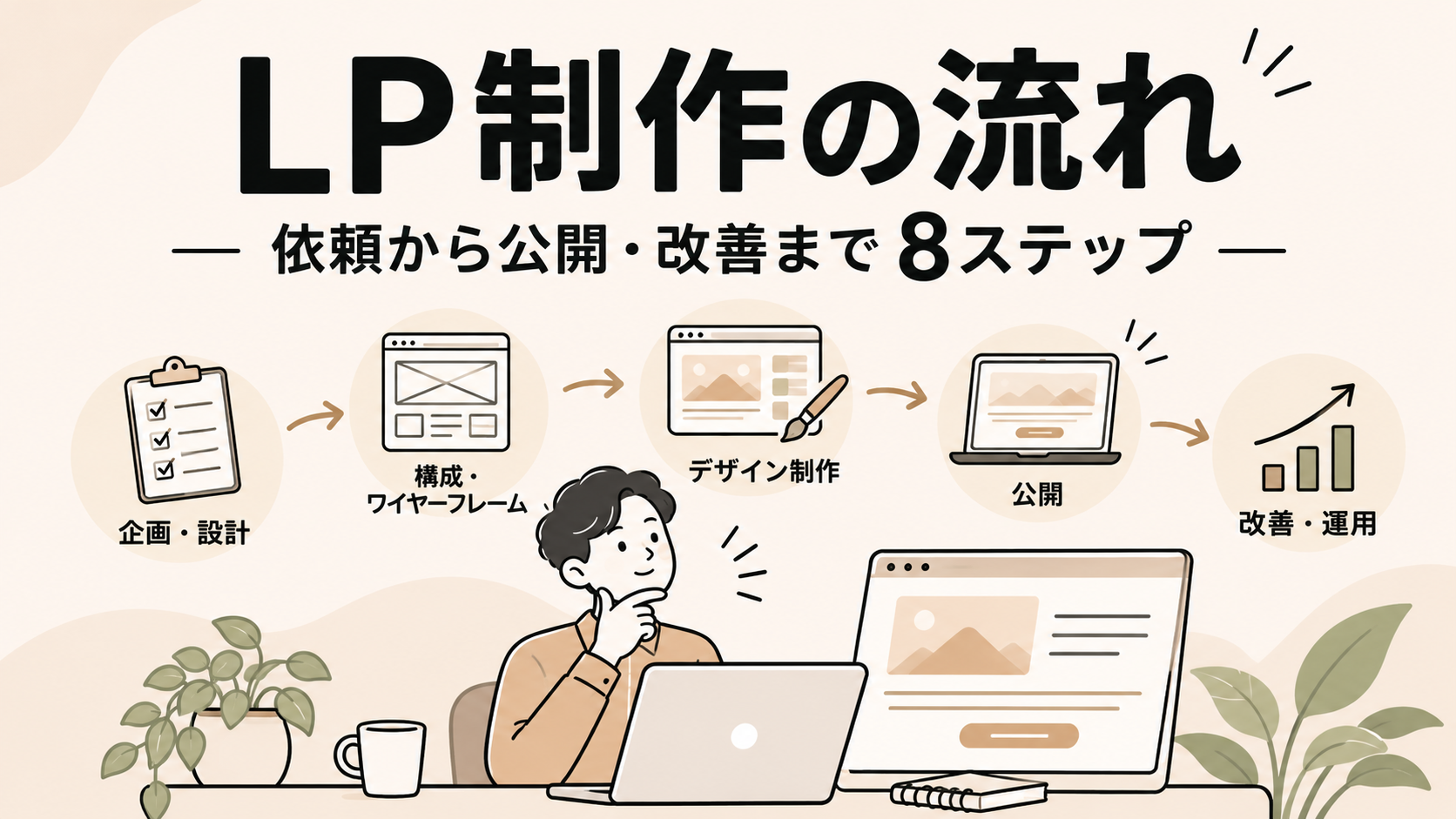
“I want to create an LP, but I’m not sure what the process involves.”
“What should I prepare before hiring a production company?”
“How long will it take, and how much will it cost?”
If you’re creating a landing page (LP) for the first time, you might be asking yourself these very questions.
Creating a landing page doesn’t start with designing it right away.
Who is your target audience? What message do you want to convey? What action do you want them to take? Once you’ve clarified these objectives, you’ll plan the structure and copy before moving on to design and coding.
I’ve been involved in web production for over 30 companies and more than 200 sites, working not only on LP creation but also on ad management and post-launch improvements.
Based on that experience, I’ve come to realize that what’s most important in LP creation isn’t just crafting the design—it’s laying a solid foundation with the initial planning.
In this article, I’ll break down the landing page production process into eight steps.
I’ll cover everything from what you should prepare before placing an order to production timelines, typical costs, and key points to check at each stage, so please use this as a reference.
What Is Landing Page Production? Let’s Start by Understanding the Basics and the Overall Process
Landing page creation involves building a web page with the specific goal of driving users to take a particular action, such as making a purchase, submitting an inquiry, or requesting information. The process follows this sequence: planning, structure, copywriting, design, coding, launch, and optimization.
What Is an LP (Landing Page)?
LP stands for “Landing Page.”
While a typical website provides a broad overview of a company or business, an LP focuses on conveying the appeal of a specific product or service and driving users to take action, such as submitting an application.
For example, they are created for the following purposes:
- To increase sales of a new product
- To increase inquiries about a service
- To gather registrations for seminars or events
- To drive requests for information or free consultations
- To boost traffic from advertisements
Landing pages are often designed as single, vertically scrolling pages, structured to help visitors understand the product or service and make a purchase or sign up right away.
However, it’s not enough to simply condense information onto a single page.
It’s important to create a structure that addresses readers’ questions and concerns while naturally guiding them toward making a submission.
The Difference Between an LP and a Standard Website
Landing pages and standard websites serve different primary purposes.
| Comparison Criteria | Landing Page | Standard Website |
|---|---|---|
| Main Purpose | Purchases, inquiries, sign-ups, etc. | To provide a broad overview of the company and its business |
| Page Structure | Primarily a single, vertically long page | Often consists of multiple pages |
| Primary Methods for Attracting Visitors | Web ads, social media, email, etc. | SEO, social media, advertising, etc. |
| How information is presented | Focus on specific products or services | Organize information about the company as a whole |
| Prioritized Outcomes | Conversions | Awareness, Trust, Inquiries, etc. |
A conversion (CV) is the achievement of a goal set for a page, such as an inquiry or a purchase.
For example, if the purpose of a landing page is to solicit sign-ups for a free consultation, the completion of the sign-up form constitutes a conversion.
Note that landing pages can sometimes attract traffic from Google Search as well. However, when designing a landing page specifically to drive traffic from ads, it is particularly important to ensure that the content of the ad matches that of the landing page.
The landing page creation process consists of 8 main steps
The general process for creating a landing page is as follows:
- Consultation and Goal Definition
- Target Audience Research and Planning
- Creating a Structure Proposal and Wireframes
- Copywriting and Tagline Development
- Design Production
- Coding and Feature Implementation
- Pre-launch Testing and Launch
- Performance Measurement and Optimization
Depending on the production company, the order of copywriting and layout planning may vary, or multiple stages may be carried out simultaneously.
Additionally, when you actually commission a project, the consultation is followed by a quote and contract process.
Let’s take a closer look at what happens in each stage and what points the client should verify.
8-Step Landing Page Production Process | From Commission to Launch and Optimization
LP production begins with defining the objectives, followed by research, structure, copywriting, design, and implementation, culminating in launch. After launch, traffic and lead generation metrics are monitored, and improvements are made as needed. Understanding what to check at each stage will help ensure the production process runs smoothly.
STEP 1 | Consultation and Defining Objectives
The first step in landing page production is a consultation to clarify your objectives and business details.
For example, we clarify the following details:
- Which products or services will be featured?
- What kind of customers do you want to attract?
- What methods are currently being used to attract customers?
- What are your strengths compared to competitors?
- What action do you want visitors to take on the landing page?
- What is your budget and desired delivery timeline?
At this stage, it’s more important to clarify the purpose of the landing page than to decide on design preferences.
For example, even for landing pages promoting the same beauty service, the content will vary depending on whether the goal is to “increase bookings for first-time trials” or to “increase requests for free consultations on high-priced packages.”
Additionally, setting your goals as specifically as possible makes it easier to measure the effectiveness of the landing page after it goes live.
In addition to the goal of “increasing inquiries,” if you can provide information such as your current number of inquiries and your target number, it will be easier for the production company to make proposals.
What the client should check: Does the production company make an effort to understand not only the details of the product or service but also the client’s customer acquisition challenges and goals?
STEP 2 | Target Audience Research & Planning
Next, we investigate what concerns people who need your products or services have and what they are looking for.
For example, when creating a landing page for a tourism experience service in Okinawa, the messaging will differ depending on whether the target audience is families, couples, or international tourists.
For families, safety and participation requirements for children may be key; for couples, the uniqueness of the experience; and for international visitors, language support and booking methods may be crucial.
At this stage, we identify your company’s unique strengths while reviewing the features, pricing, and customer reviews of competing services.
Then, we determine the key message we want to convey on the landing page.
For example, try comparing the following two options:
“Enjoy Marine Activities in Okinawa”
“No worries even on your first trip to Okinawa. A private marine experience you can enjoy with young children”
The latter conveys more specifically who the service is intended for, doesn’t it?
Of course, the actual content of your message must be based on the features and facts of the service you’re offering.
In this way, deciding who to target, what to communicate, and how to convey it is the essence of landing page planning and design.
What the client should verify: Whether the target audience and messaging devised by the production company align with the actual customers.
STEP 3 | Creating a Structure Proposal and Wireframes
Once the direction of the plan is decided, we consider the overall structure of the landing page.
At this stage, we create what is called a wireframe—a blueprint of the page.
Wireframes are used to organize where headings and images will be placed and in what order the information will be presented.
For example, for a landing page designed to encourage service sign-ups, the following structure might be considered:
- First View (The First Screen Visible)
- Customer Concerns and Challenges
- Benefits of the Service
- Service Features and Reasons to Choose It
- Track Record and Customer Testimonials
- Pricing & Plans
- Step-by-Step Guide to Getting Started
- Frequently Asked Questions
- Sign-Up Form & Contact Button
However, the same structure isn’t suitable for every landing page.
For example, if an ad is aimed at people who are already familiar with the product, it may be better to communicate pricing and how to sign up early on.
On the other hand, for a landing page aimed at people encountering the product for the first time, it may be important to carefully explain its necessity and benefits.
When reviewing wireframes, focus on the “content and order of presentation” rather than colors or decorative elements.
Identifying any missing information during the layout phase makes it easier to prevent major revisions later on.
What the client should check: Does the page include all the information customers want to know, and is the flow designed to guide them through the sign-up process while addressing any questions they may have?
STEP 4 | Creating Copy and Taglines
Once the landing page structure is finalized, you’ll create the actual text to be displayed.
On a landing page, the catchphrase in the first view is particularly important.
The “first view” refers to the portion of the page that appears immediately upon opening it.
Whether visitors feel that “this service is relevant to me” significantly influences their subsequent browsing behavior.
For example, instead of saying, “We create high-quality websites,” stating, “For small and medium-sized businesses looking to increase inquiries through their websites,” may more effectively convey your purpose to your target audience.
However, a catchphrase isn’t effective simply because it stands out.
It’s important that it aligns with the actual features of your product or service.
When drafting copy, organize the following information as well:
- Features and benefits of the product or service
- Pricing and plan details
- Track record and case studies
- Frequently Asked Questions
- Steps to Start Using the Service
- Conditions to Know Before Applying
Even if you commission a production company to create the copy, you must still provide information about your products or services.
This does not mean you can simply say, “I’ll leave the writing to you, so I don’t need to prepare anything.”
To ensure the production company can accurately convey the appeal of your service, please share actual customer testimonials and frequently asked questions.
Points the client should verify: Are the details—such as pricing and track record—accurate? Are there any exaggerated claims? Is the copy written in a way that resonates with actual customers?
STEP 5 | Design Production
Once the structure and direction of the copy have been decided, we move on to the design phase.
This is when we begin to concretely refine the landing page’s visual appearance using colors, fonts, photos, and white space.
In landing page design, it’s not just about looking stylish—it’s also crucial that the information is easy to understand.
For example, you might highlight the key benefits you want to convey most prominently and ensure that pricing and sign-up methods are easy to find.
Display on smartphones is also important.
Because smartphone screens have limited width, even a design that’s easy to read on a computer may end up with text that’s too small or buttons that are difficult to tap.
When reviewing the design with the production company, keep the following points in mind:
- Does the first screen clearly convey the service details?
- Is the tagline easy to read?
- Are the photos of products and services clear?
- Is the sign-up button easy to find?
- Is the content easy to read on a smartphone?
- Does the overall design suit the target audience?
If there are any points you’d like to revise, it helps to explain the reasons behind them—rather than just saying, “It just doesn’t feel quite right.”
For example, you might say, “I want to convey a sense of luxury, so I’d like to reduce the number of colors,” or “I want to make it easier to compare prices, so I’d like to reorganize the table.”
Please note that changing the overall page layout after the design is complete may require additional work.
It’s important to review the layout during the layout phase and the design during the design phase.
What the client should check: Beyond personal design preferences, ensure the screen presents information clearly to the target audience and makes it easy for them to submit an application.
STEP 6 | Coding and Feature Implementation
Once the design is finalized, we build the pages so they can be displayed on the web.
This process is called coding.
We use HTML, CSS, JavaScript, and other technologies to recreate the design as a web page.
We also implement features such as contact forms, booking functionality, and analytics tools as needed.
At this stage, it’s important to verify mobile responsiveness and form functionality.
For example, even if a page displays correctly on a computer, text may overlap or buttons may extend beyond the screen when viewed on a smartphone.
Furthermore, if the contact form cannot be submitted properly, you won’t be able to accept inquiries even if your landing page attracts a lot of traffic.
During implementation, we verify the following points:
- Whether the layout is broken on desktop or smartphone
- Do buttons and links function correctly?
- Can the contact form be submitted?
- Are input errors displayed clearly?
- Are there any major issues with page load speed?
- Are the necessary web analytics and ad tracking tools set up?
If you use Google Ads, it’s also important that the ad content matches the landing page content.
Google advises prioritizing the relevance between ads and landing pages, as well as mobile usability.
Reference: Google Ads Help “Optimizing Ads and Landing Pages”
What the client should verify: Can the site be viewed and navigated without issues on an actual smartphone? Can submissions and inquiries be sent correctly?
STEP 7 | Pre-launch Check and Launch
Once coding is complete, perform a final check before publication.
In this step, it’s important to verify not only the visual appearance but also that the published information and functionality are correct.
For example, check the following items:
- Are there any errors in product or service names?
- Are the prices, campaign periods, and eligibility requirements correct?
- Are there any typos or missing characters?
- Do all links lead to the correct pages?
- Does the contact form work properly?
- Are automatic reply emails and notification emails being delivered?
- Is the layout displayed correctly on smartphones and computers?
- Check that ad tracking and web analytics are working correctly
In particular, if you’re using ads to attract visitors, be sure to verify the form and tracking settings before launching your ad campaign.
Even if your landing page is live, it will be difficult to assess the effectiveness of your ads if conversions aren’t tracked correctly.
It’s also important to verify the display and functionality using the actual URL after launch.
Even if there are no issues in the test environment, behavior may differ in the live environment depending on the settings.
What the client should verify: Is the content accurate, and can users submit applications without issues via the actual URL? If launching an ad campaign, are the tracking settings fully configured?
STEP 8 | Performance Measurement and Optimization (LPO)
Launching the landing page isn’t the end of the process.
After launch, monitor actual traffic and the number of submissions, and make improvements as needed.
This process is called LPO (Landing Page Optimization).
For example, if many people are visiting the landing page from ads but the number of sign-ups is low, there may be room for improvement in the tagline, how pricing is presented, or the sign-up form.
On the other hand, if the landing page’s conversion rate isn’t bad but traffic is low, it may be better to review your ad targeting settings or customer acquisition methods.
The key metrics to monitor after launching a landing page are as follows:
| Metrics | Meaning |
|---|---|
| Number of Visits | How many people visited the landing page |
| Number of Conversions | How many actions, such as inquiries or purchases, occurred |
| CVR | The percentage of visits that resulted in a conversion |
| CPA | The cost incurred to generate one conversion through advertising or other channels |
| Number of form submissions and completions | The number of people who reached the application form and the number who completed it |
CVR refers to the conversion rate, while CPA refers to the cost per acquisition. The interpretation varies depending on what is actually being measured as a conversion.
One method for improvement is A/B testing.
A/B testing is a method of comparing, for example, two different versions of a tagline to determine which one is more likely to lead to results.
However, when traffic is low, it’s impossible to determine which is better based on only a slight difference.
It’s best to first check for obvious issues—such as form malfunctions or missing information—and then proceed with the testing.
Points the client should clarify: Who will review the data after launch? Are improvement efforts included in the production cost? Can we consult with you regarding ad management?
What to Prepare Before Commissioning an LP
To ensure the landing page production process runs smoothly, it’s helpful to organize information about your products or services, photos, logos, case studies, and your desired launch date. However, you don’t need to have all materials perfectly prepared before consulting with the agency.
Pre-Commissioning Preparation Checklist
Before consulting with a production company, please review the following items.
| Items to Prepare | Specific Details |
|---|---|
| Product and Service Information | Features, pricing, scope of services, terms of use |
| Target Audience Information | Target Audience, Common Concerns |
| Track Record and Customer Testimonials | Case Studies, Reviews, and Testimonials (with permission to publish) |
| Photos and Images | Product photos, service scenes, staff photos, etc. |
| Logos and Brand Materials | Logo files, brand colors, reference websites |
| Advertising and Customer Acquisition Plans | Google Ads, Meta Ads, social media, etc. |
| Budget and Desired Delivery Date | Production Budget, Desired Launch Date |
| Deployment Environment | Domain, server, information about existing websites, etc. |
Information about your products and services is particularly important.
Even if you entrust the copywriting to a production company, you—as the client—are likely the one who knows the most about the background of your product’s development, its strengths, and the questions customers frequently ask.
Sharing this information makes it easier to create more specific and persuasive copy.
Can I place an order even if I don’t have all the copy or photos ready?
Even if you don’t have all the copy or photos ready, you can still consult with a production company.
Depending on the production company, some offer services such as drafting copy based on a consultation or suggesting photo materials.
However, there may be additional fees for copywriting, photography, or purchasing images.
Additionally, if photography or copywriting takes time, the overall schedule may be extended accordingly.
Be sure to confirm at the quote stage exactly what services they can provide.
Designate a person to handle mid-production reviews
During the creation of a landing page, you may be asked to review various stages, such as the layout proposal and design.
If multiple people within your company need to approve these at each stage, it can be difficult to reach a consensus on revisions, which may bring the production process to a halt.
Ideally, designate a single point of contact for the production company and a person responsible for making the final decisions to ensure a smooth process.
Also, be sure to set aside the necessary time for reviewing structure proposals and designs.
How long does it take to create an LP?
Generally, the production period for an LP ranges from a few weeks to about two months. However, this can vary depending on factors such as the page length, whether copy needs to be written, the features required, the readiness of materials, and the time needed for review and revisions.
The production timeline varies depending on the stage of the process
For example, the production timeline will differ depending on whether you already have the copy and photos ready, or if you’re outsourcing everything from planning to copywriting.
Generally, the following stages take the most time:
- Consultation and Planning
- Drafting the Structure and Copy
- Design Production and Revisions
- Coding and Form Implementation
- Final Review and Launch
For example, if the service’s features and copy have already been organized, it becomes easier to proceed with planning the structure and design.
On the other hand, if we need to start from the product concept, it’s important to allocate sufficient time to the planning phase.
At AT.DESIGN, while the timeline varies depending on the scope and content of the landing page, we generally estimate a timeframe of approximately 2 weeks to 2 months.
We are open to discussing short turnaround times, but the conditions under which we can accept such requests vary depending on the scope of work and schedule.
Tips for Shortening the Landing Page Production Schedule
To ensure a smooth landing page production process, keep the following points in mind.
- Clarify the Purpose of the Project from the Start
- Prepare materials such as copy and photos well in advance
- Designate a single point of contact for the production company
- Set a deadline for reviewing the layout proposal and design
- Compile and communicate revision requests
- Work backward from the ad launch date or campaign start date
One thing to be especially careful about is making major changes in direction during the production process.
For example, if you decide after the design is complete that you “want to change the target audience” or “want to present the service differently,” it may become necessary to redo the structure and copy from scratch.
Rather than rushing into design production, taking the time to clarify your objectives and messaging from the start can ultimately reduce the need for rework.
Average Costs for Landing Page Production and Factors That Affect Pricing
The cost of landing page production varies depending on whether you commission only the design or entrust the entire process—including planning, structure, copywriting, and coding—to the agency. If you commission a production company to handle the entire project, a budget of approximately 300,000 to 600,000 yen is a general guideline.
Average Costs for Landing Page Production
The cost of landing page production varies significantly depending on the agency and the scope of work.
According to order data published by Web Kanji, the average cost for landing page production orders placed between July 2023 and June 2026 was 394,000 yen, with a median of 300,000 yen.
Additionally, a budget range of 300,000 to 600,000 yen is cited as a general guideline for projects where you commission the agency to handle everything from planning to production.
Reference: Web Kanji, “Average Costs for LP (Landing Page) Production”
However, these are merely reference values based on actual order data.
Actual quotes will vary depending on factors such as page length, required features, and whether copywriting or photography is needed.
Key Factors Affecting LP Production Costs
| Item | Reasons for Cost Variations |
|---|---|
| Planning and Structure | Scope of market research, competitor analysis, and messaging strategy |
| Copywriting | Whether to Outsource Copywriting |
| Design | Page Length and Scope of Original Production |
| Photos and Videos | Is photography or media production required? |
| Coding | Inclusion of animations or special features |
| Forms and External Integrations | Integration with booking, payment processing, customer management, etc. |
| Metrics Setup | Scope of web analytics and ad performance measurement |
| Post-launch improvements | Analysis, revisions, A/B testing, and other measures |
For example, the amount of work required differs depending on whether your company prepares the copy in-house or outsources even the sales copywriting to a production agency.
Additionally, advertising costs and fees for managed ad campaigns may apply separately from the landing page production costs.
When requesting a quote, be sure to confirm what is included in the production cost and where additional charges may apply.
About AT.DESIGN’s Landing Page Production
At AT.DESIGN, we typically offer landing page production services at prices ranging from the 200,000-yen to 500,000-yen range.
The actual cost varies depending on whether copywriting is included, the scope of the project, and the page volume.
In addition to planning, structure, design, and coding, we’re also available to consult on managing campaigns such as Google Ads and Meta Ads, as well as post-launch optimizations.
For more details, please see our Landing Page Production Services page.
5 Key Points to Keep in Mind to Avoid Failure in Landing Page Production
When creating a landing page, it’s important not to focus solely on refining the design; you must also consider your objectives, target audience, copy, integration with ads, and post-launch improvements. In particular, it’s crucial not to be vague about the initial design.
① Don’t Start with the Design
When considering landing page creation, many people look for stylish designs to use as inspiration.
Of course, design is important.
However, if you haven’t decided who you’re targeting or what message you want to convey, even a visually polished page won’t necessarily lead to conversions.
We recommend first clarifying your target audience and objectives, and then developing a design to convey that message.
② Provide supporting evidence, not just a catchphrase
Phrases like “high quality,” “high satisfaction,” or “the top choice” may not fully convey the appeal of your service on their own.
For example, it’s easier to convey your message when you include information that helps users make an informed decision—such as specific service details, a track record of successful cases, and user testimonials.
However, when publishing track records or statistics, be sure to verify the evidence and take care not to make statements that differ from the facts.
While taglines are meant to grab attention, convincing information is also crucial for those considering signing up.
③ Ensure the content of your ads matches that of your landing page
When driving traffic from an ad to a landing page, it’s crucial that the content of the ad matches the content of the landing page.
For example, if an ad states “First-time trial: 1,000 yen” but visitors cannot find that information when they open the landing page, they will be confused.
Google Ads also places a high priority on the relevance between ads and landing pages.
If you’re outsourcing the creation of your landing page and ad separately, make sure the respective teams share the key messaging.
④ Keep the sign-up form simple
Even if visitors read through the entire landing page, they may abandon the page if the sign-up form is difficult to use.
Especially on smartphones, you’ll want to check whether there are too many fields to fill out, whether error messages are clear, and whether the submit button is easy to press.
However, this doesn’t mean you should simply omit necessary information.
For example, if there are specific requirements for a quote, you need to verify them appropriately.
Design the form by balancing the user’s burden with the information the business needs.
⑤ Create with Post-Launch Improvements in Mind
A landing page isn’t necessarily complete the moment it goes live.
By analyzing actual traffic and ad data, you may uncover issues you hadn’t anticipated.
For example, if the “Apply” button isn’t being clicked often enough, you can try adjusting its position or revising the surrounding text.
If users are reaching the form but few are completing submissions, you may need to review the input fields or error messages.
To implement these improvements, it’s important to plan your tracking methods before the page goes live.
How do you choose a company to create your landing page?
When selecting an LP production company, look beyond just their portfolio and design skills; check how comprehensively they handle planning, copywriting, ad management, and post-launch optimization. It’s crucial to ensure you’ll receive support tailored to your specific goals.
Don’t Judge a Company’s Track Record by Appearances Alone
When reviewing a landing page agency’s portfolio, in addition to the quality of the design, check what kinds of products or services they’re showcasing.
For example, the required structure and design elements differ between an LP aimed at generating inquiries and one aimed at driving product purchases.
It’s a good idea to ask if they have a track record similar to your company’s goals and what specific challenges they addressed when creating those pages.
Can they handle copywriting and ad management?
In landing page production, both design and copy are important.
Therefore, be sure to confirm whether you’ll need to prepare the copy yourself or if the production company will create it based on a consultation with you.
Also, if you plan to run ads after the page goes live, it’s a good idea to confirm whether you can consult with them about ad management as well.
If the agency understands both landing pages and advertising, it will be easier to ensure consistency between the ad’s messaging and the landing page’s content.
Check the post-launch improvement process
Making improvements to the landing page after launch can lead to better results.
However, depending on the production company, post-delivery analysis and revisions may not be included in their scope of services.
Before signing a contract, be sure to confirm the following points:
- Are minor revisions possible after launch?
- How much do revisions cost?
- Can they set up web analytics for you?
- Can we review the results of ad campaigns together?
- Can you request ongoing improvements?
Choosing a company that you can consult with from the production stage through to subsequent management will make it easier to utilize your landing page over the long term.
Frequently Asked Questions About the Landing Page Production Process
Finally, we’ve compiled a list of questions that first-time clients often have. Please use this as a reference before placing an order—covering topics such as production timelines, copywriting, and WordPress integration.
How long does it take to create a landing page?
It varies depending on the scope of the project, but a general guideline is anywhere from a few weeks to about two months.
If the copy and photos are already prepared, the process can sometimes be completed relatively quickly. On the other hand, if planning, copywriting, or photography are required, it may take longer.
At AT.DESIGN, we estimate a timeframe of approximately 2 weeks to 2 months, depending on the scope of the project.
When commissioning a landing page, do I need to prepare the copy myself?
Whether you need to prepare the copy yourself depends on the production company you hire and the plan you choose.
Some plans require you to prepare the copy in-house, while others involve the production company creating it based on a consultation.
Even if you commission the copywriting, you’ll still need to provide information about your products or services, your track record, pricing, and so on.
Can I create a landing page using WordPress?
Yes, it is possible to create a landing page using WordPress.
You can either add the landing page to an existing WordPress site or create it as a standalone page.
However, WordPress isn’t strictly required. It’s best to choose based on your update needs, the features you’ll use, and how you plan to manage the site.
Can I create a landing page on my own?
Yes, you can create a landing page yourself using no-code tools, WordPress, or other options.
However, creating the design and planning a structure that leads to conversions are two separate tasks.
Even if you’re building it yourself, it’s important to clearly define your target audience, your key messaging, and the conversion funnel.
Will I see an immediate increase in inquiries once I publish the landing page?
Simply publishing a landing page doesn’t guarantee an increase in inquiries.
You’ll need to figure out how to drive traffic to your landing page from sources like Google Ads, Meta Ads, and social media.
Additionally, if you’re getting traffic but it isn’t leading to sign-ups, it’s important to improve the landing page’s content and conversion flow.
Are there separate fees for landing page creation and ad management?
Generally, landing page production fees and advertising costs—including advertising management fees—are set separately.
However, some production companies may offer package deals.
When requesting a quote, be sure to confirm whether ad setup and management, banner creation, tracking setup, and post-launch improvements are included.
Summary: Initial Design and Post-Launch Optimization Are Key to Landing Page Creation
In landing page production, you first clarify your objectives and target audience before creating the design, then proceed to the structure, copywriting, design, and coding phases.
Let’s review the eight steps introduced here.
- Consultation and Defining Objectives: Determine who to target, what message to convey, and what results to aim for
- Target Audience Research & Planning: Identify the customer’s pain points and your company’s strengths
- Creating a Structure Proposal and Wireframes: Determine the order in which information will be presented
- Copywriting and Tagline Creation: Clearly convey the appeal of your service
- Design Production: Develop a visual presentation tailored to the target audience
- Coding and Feature Implementation: Turning the design into a fully functional website
- Pre-launch checks and launch: Verifying published content, forms, and analytics settings
- Performance Measurement and Optimization: Continuously making data-driven improvements to drive results
Based on my experience creating landing pages and managing advertising campaigns, I prioritize not only the aesthetic appeal of the finished design but also ensuring that visitors can take action without hesitation.
Creating a landing page isn’t an end in itself.
They exist to reach people who need your products or services and to drive results such as inquiries and purchases.
That’s why I recommend paying close attention to the design phase before production and continuing to refine and optimize the landing page even after it goes live.
Please feel free to contact us about landing page creation and ad management
“This is my first time creating a landing page, so I don’t know where to start.”
“I’d like to have everything handled for me, from copywriting to layout.”
“I’d like to discuss ad management with you as well.”
If you have any concerns like these, please feel free to contact us.
At AT.DESIGN, we provide end-to-end support—from planning, structure, design, and coding to ad management and post-launch optimization.
Our CEO will personally handle everything from the initial consultation through production and propose the necessary production plan tailored to your business objectives and budget.
It’s okay if you haven’t decided on the specifics yet.
Consult with us about landing page creation and ad management